
Nikro Air Duct Cleaning in Modesto: A Homeowner’s Guide
Most duct cleaning quotes in Modesto sound identical on the phone. Every company claims “professional equipment” and “thorough cleaning,” but nobody tells you what the machine actually does or why it matters. A shop vac pulls roughly 100 CFM. A Nikro negative-air machine pulls 2,000+ CFM, and that gap is the difference between debris that gets fully extracted and debris that gets stirred up and redeposited throughout your ductwork. If you’d rather not wade through the sales pitches alone, call (866) 256-3971 and we’ll walk you through it.
What Does a Nikro Machine Actually Do That a Shop Vac Can’t?
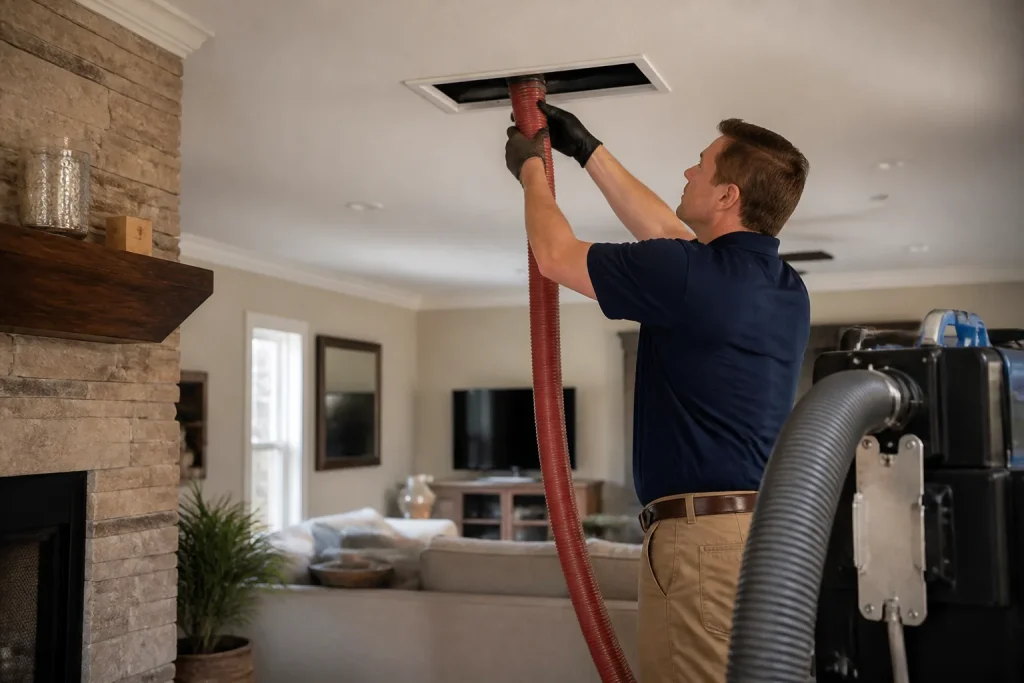
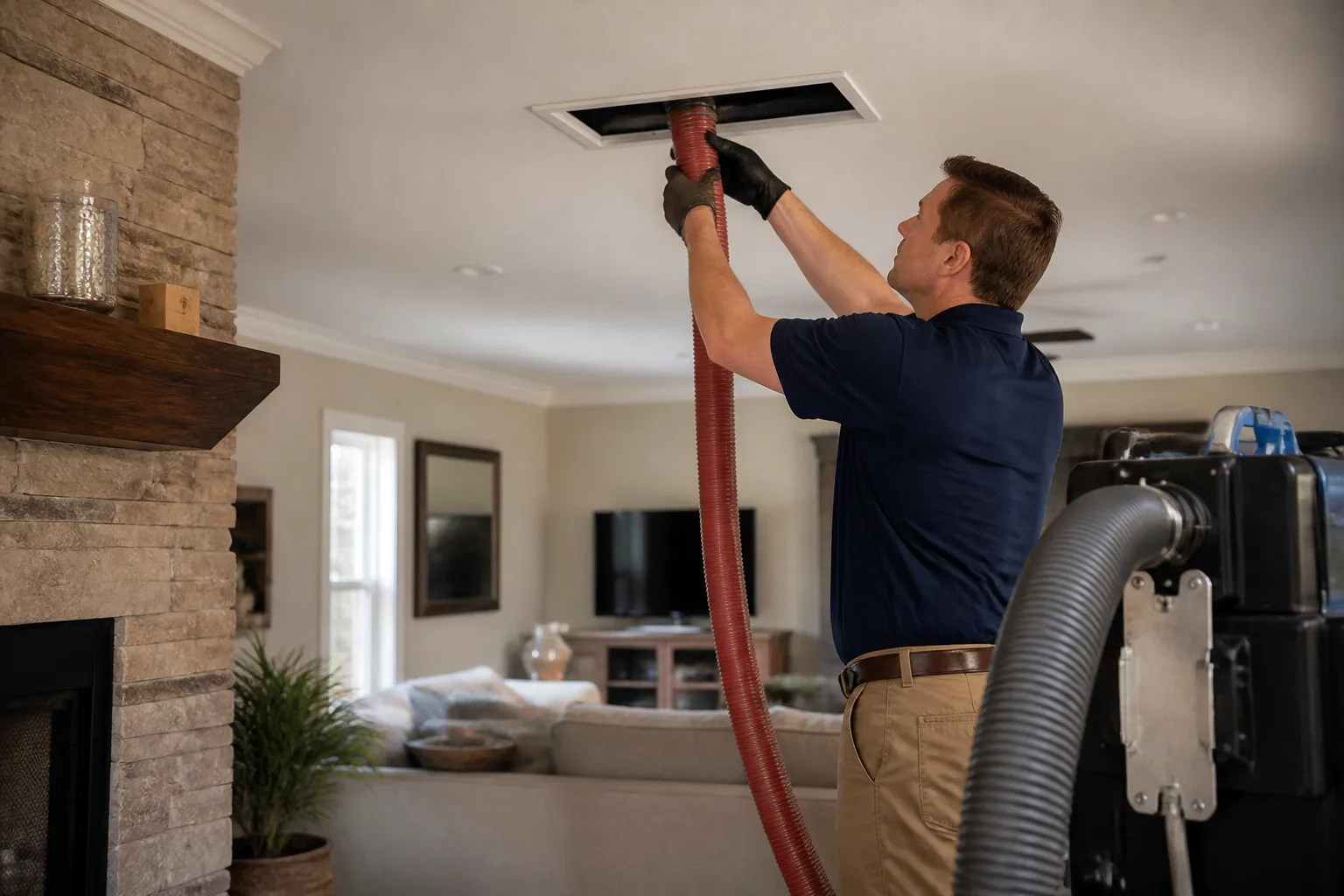
A Nikro negative-air machine pulls the entire duct system into negative pressure, then HEPA-filters the exhaust so nothing escapes back into your living space. During cleaning, the rotary brush loosens debris from the duct walls while that 2,000+ CFM of suction carries it out through a sealed collection point. The two functions – loosening and extracting – have to run at the same time to work. A machine that agitates but can’t extract just moves the problem around.
The CFM rating is the number homeowners should ask about first. CFM means cubic feet per minute – the volume of air the unit can move. Under 1,000 CFM, the machine can’t keep up with what a rotary brush loosens. You end up with a system that’s been scrubbed but not cleared, and some of what came off the duct walls settles back into the same runs it just left. In Modesto homes with long trunk lines feeding multiple rooms, that settling effect is more pronounced, because the debris has more distance to travel before it reaches the collection point.
The second spec that matters is HEPA filtration on the exhaust. Without it, a high-CFM machine becomes a very efficient way of pumping fine dust into the room where it’s working. The HEPA stage captures particles at the micron level before the air leaves the unit. Both specs – CFM and HEPA – have to work together. One without the other doesn’t clean anything; it just moves contaminants around.
Why Does Negative Pressure Have to Be Established Before Cleaning Starts?
Negative pressure means there’s less air pressure inside the duct system than in the room around it. Air flows inward, not outward. That’s the whole point. If the system isn’t under negative pressure before the brush touches a duct wall, any debris that gets loosened can escape through gaps, register boots, or the return air grille into the room you’re standing in.
In our experience, the setup phase is where a professional job separates itself from a half-finished one. Here’s what the sequence typically looks like:
- Collection point established at the main trunk or plenum. The Nikro unit connects to the duct system through a single high-volume port, usually at the air handler connection or a return plenum.
- Every register and grille is sealed. Each supply and return opening gets covered, so the only place air can enter the system is through the machine’s collection hose.
- The negative-air machine is switched on and allowed to stabilize. Pressure needs to drop throughout the whole system before agitation starts.
- Rotary brush agitation begins. A technician feeds the brush down each branch run, working from the furthest register back toward the collection point.
If a company skips the sealing step or doesn’t wait for pressure to stabilize, the “negative pressure” claim is a marketing line, not a method. A Modesto homeowner can verify the setup by watching the technician seal each register before any cleaning begins. If the brush is running and the registers are open, something is wrong.
What Does a Nikro-Equipped Job Look Like on Site?
When the right equipment is set up properly, the job follows a predictable pattern. Knowing what to expect helps you spot a job that’s being done by someone with a real cleaning protocol versus someone who showed up to point a hose at your registers for 20 minutes.
The setup starts with locating the air handler and the main trunk. The collection hose connects there, and the negative-air machine is positioned so its exhaust routes somewhere harmless. Every register in the home gets covered with foam, plastic sheeting, or a magnetic seal, depending on the boot style. The technician confirms the system holds pressure by listening for air leaks at the seals and checking the machine’s gauges.
Rotary agitation comes next, room by room. The Rotobrush system feeds a rotating brush head into each duct run, scrubbing the walls while the Nikro machine pulls everything toward the collection point. When the run is clean, the technician moves to the next branch. Some companies use Guardsman-brand protective products at the end of the process to finish the inside surfaces of clean duct walls.
For homes in Modesto with older metal ductwork, the brush can reach mineral deposits and settled dust that a vacuum alone won’t move. Newer flex duct runs need a gentler agitation approach because the corrugated lining can tear under aggressive brushing. The high-CFM extraction stage matters more in those homes, because the ribbed inner surface traps debris in the grooves. An experienced technician adjusts the brush speed and dwell time to the duct material. If you’re curious how a full cleaning fits into a broader maintenance routine, our Duct Cleaning Modesto page walks through the whole scope.
What Questions Should You Ask Before Booking Any Duct Cleaning Company in Modesto?
Ask these before you book. A company with the right equipment will answer them clearly. A company without it will deflect, get vague, or move straight to pricing without addressing the method.
- “What machine do you use, and what’s its CFM rating?” If the answer is under 1,000 CFM, the equipment can’t keep pace with rotary agitation. A shop vac level of suction is not a cleaning system.
- “Is the exhaust HEPA-filtered?” If not, the unit is venting fine dust back into your home’s air. HEPA filtration isn’t a premium add-on – it’s a basic requirement.
- “How do you establish negative pressure, and how do you verify it?” You’re looking for a description of sealed registers and a collection hose connected at the plenum. Vague answers here mean the method isn’t real.
- “Will the technician identify the duct material before agitation?” Metal and flex duct need different brush settings. A company that treats every duct the same will damage flexible runs.
- “When was the last time you used Abatement Technologies-grade containment in a residential job?” This tells you whether the company is equipped for routine cleaning or has invested in higher-containment capability for sensitive situations.
- “What does a full system clean cost for this house?” A whole-system estimate, not a per-register quote. For context, typical air duct cleaning in Modesto runs roughly $350 to $650 for a single residential system, depending on the number of runs, access difficulty, and whether minor duct repair is needed. Written estimates are what set the final price.
Why Do Old Metal Ducts and Newer Flex Ducts Need Different Approaches?
Metal ductwork in many Modesto homes has been in place long enough to develop mineral deposits, settled dust layers, and hairline gaps at the seams. The debris tends to be heavier and more compacted. High-CFM extraction moves it well because the airflow can lift those older deposits once the brush breaks their bond to the surface. The rigidity of metal also means aggressive rotary brushes can do a deeper pass without risking damage to the duct structure.
Flex duct behaves differently. The inner lining is a corrugated plastic sheath. Debris collects in the grooves along the entire run, not just at the transitions. Aggressive brushing can abrade or snag the lining. What matters more in flex runs is sustained, high-CFM extraction pulling air through the corrugated surface for a longer dwell time. An experienced technician working with Nikro equipment in a flex-duct Modesto home will reduce brush speed and run the extraction stage longer, allowing the negative-pressure airflow to lift debris from the grooves.
Homes with a mix of both – metal trunk lines feeding flexible branches, which is common here – need the technician to switch approach mid-job. If you notice symptoms like chronic dust after a professional cleaning, that’s usually a sign the duct system has gaps or disconnected joints the cleaning missed. That’s when our air duct cleaning page becomes relevant, because it covers the full scope including inspection for damage.
When Should You Call a Professional Instead of Waiting?
If you’ve asked the right questions and the company on the phone can’t describe its CFM rating or its HEPA setup, keep looking. Same if a company quotes based on the number of registers without seeing the system. In our view, the setup step – sealing every vent, connecting the collection point at the plenum, waiting for pressure to stabilize – is the part most likely to get skipped. That skipped step is exactly why some jobs leave a Modesto home feeling dustier afterward than before.
One more element worth asking about: safety. Air duct cleaning addresses what you’re breathing. dryer vent cleaning addresses a separate hazard – lint buildup in the vent line, which is one of the leading causes of residential fires. The two should be treated as separate services. If a company offers dryer vent cleaning as a $50 add-on and runs a shop vac through the line for five minutes, that’s not a safety service. It’s a checkbox. Proper dryer vent cleaning requires reaching the full run from the dryer connection to the exterior termination and removing the compacted lint that has built up over time. Guardsman-brand products are often used to protect the duct integrity afterward.
When you’re ready for a name-brand equipment quote from a company that can describe the machine before the price, that’s what we do. If you’d like this kind of work done right in Modesto, call us for a written estimate.
Related services in Modesto: Air duct cleaning, air duct repair, and dryer vent cleaning, all handled by the same team.
The Bottom Line
Ask what machine gets used. Ask the CFM rating. Ask whether the exhaust is HEPA-filtered. Ask how negative pressure gets established and verified. A company that uses Nikro negative-air equipment and Rotobrush rotary systems will answer all four without hesitating, because those questions describe exactly what they do. A company without that equipment will pivot to price. Our technicians have up to 13 years of experience and use professional-grade equipment on every job, not consumer shortcuts. If you’re in Modesto and want to talk through what a proper cleaning involves for your home, Duct Cleaning Modesto offers free estimates. Call (866) 256-3971. We answer 24/7. Fast dispatch from 7am to 7pm, Sunday through Friday.
Frequently Asked Questions
Yes. A Nikro negative-air machine pulls 2,000+ CFM with HEPA-filtered exhaust, while a shop vac typically pulls around 100 CFM with no HEPA stage. The difference is whether debris gets extracted from the system or merely stirred up and redeposited. That gap affects the outcome directly. Call (866) 256-3971 for a free estimate if you’d like to know what equipment we’d use on your home.
Typical residential air duct cleaning in Modesto runs roughly $350 to $650 for a single system, depending on the number of runs, system size, and whether minor duct repair is needed. Whole-system pricing is what you should be quoted – per-register pricing is a red flag because it encourages a company to spend five minutes per vent and call it done. Call (866) 256-3971 for an exact quote – estimates are free.
Watch the setup. Every register and grille should be sealed before any agitation starts, and the collection hose should be connected at the plenum or main trunk. If the brush is running while registers are open, the system isn’t under real negative pressure and dust is escaping into your rooms. Ask the technician to point out the seals and explain how they verify pressure. Call (866) 256-3971 if you’d like to ask us these questions before booking.
Most homes in Modesto benefit from cleaning every 3 to 5 years, sooner if you’ve had renovations, a pet-heavy household, or visible dust blowing from registers after a recent clean. Newer construction that generated drywall dust during install typically needs a first cleaning sooner than the builder might suggest. If you’re unsure, call (866) 256-3971. We answer 24/7 and can walk through timing for your specific situation.
Written by the team at Duct Cleaning Modesto.
Need Air Duct Cleaning Help?
Call Duct Cleaning Modesto - licensed & insured, with free written estimates in Modesto.
(866) 256-3971